Wednesday, September 18, 2019

Swing Dancing and Braces

Swing dancing originated in the 1920s, and is connected with Jazz and Big Band music. Style reflects culture and this was true during this period. Dancers took up the clothing of time, which was heavily influenced by the social ideas of the day. Style was reflected in music, which was flamboyant, easy-going, and unique. 

Swing dancing was meant to be fun and relieve stress. It was a social activity that allowed you to connect with people. All ages came together at the dance hall to meet others, talk, and usually dance.

Here's some videos to illustrate the style, music, and dance. 

Here's some lindy hop dancers from the movie Day at the Races (1937) and a color version here. All of the male dancers wear braces to keep their high-rise pants high! The opening dance off with the portly man shows how useful braces are to swing dancers - he would not be able to pull off his moves and keep his pants from sliding down without the help of braces.

This man's ready to dance, wearing braces with his high-rise trousers

During this era women wore knee-length, pleated or circular skirts and dresses in flamboyant colors. The key was that the bottom half had plenty of material for dancing and allowed the material to flow wave like a flag. If wearing a skirt, it was usually high-waisted, sometimes with braces or simple straps over the shoulders to accommodate the high waist. 

A classy swing, circular skirt with built-in shoulder straps

Men always wore full suits: a jacket and tie, and sometimes a vest. Akin to the ladies style, men’s suit pants were high-rise held up with button-on braces.

Another example is from the 1943 movie, "Kid Dynamite". The scene opens with 2 ladies pinning dance numbers on the back of their partner's suit jackets. The ladies are both wearing high-waisted skirts with suspender straps attached. One lady's straps cross in the back and the other lady's straps do not. As you'll find out, this causes a problem.

The men are wearing suits. During the scene, as the dancers move around, the jackets open and we catch glimpses of high-waisted pants, which would have been held up with braces. 


The dancing commences and dancers start to boogie and move in all different positions. They twist and turn and enjoy dancing. It's a fantastic time. At the 3:25 mark, the lady's right suspender strap slips off her shoulder. Her straps don't cross in the back, and with all the movement, the strap can't stay in place on her shoulder. Switching back to the other dance partners, the lady's crossed shoulder straps are in place even though she's widely dancing around as well. The song ends and the lady pulls her suspender strap up again. This would get annoying, and is the reason for crossing the straps in the back.

Here's another video that illustrates both of these styles: a pair of lindy hop dancers, Dean and Jewel. They are wearing quintessential swing dance outfits: Dean is wearing white, high-rise pants with braces, and Jewel is wearing a flamboyant skirt with shoulder straps. Her vertical straps have a horizontal strap in the same fabric across her bust, which keeps her straps in place, regardless of her vigorous movement.

Coles and Atkins jazz dancers in classic high-rise trousers with braces and suit jacket

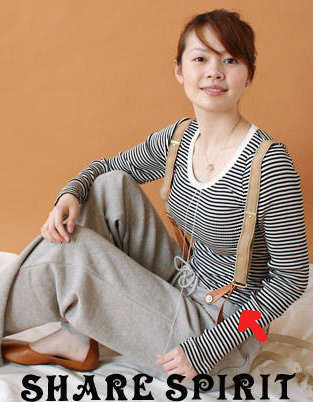
And finally, women sometimes opted for high-rise trousers when dancing and wore suspenders with them, such as this lady:

Lady dancer wearing Lederhosen-style suspenders

I find it interesting that both women’s and men’s styles have two common features:

  1. Roomy and comfortable fit: the clothes were not skin tight or overly baggy. Skirts and pants were roomy to allow air movement and flow of the fabric; they were not tight or restrictive.
  2. High-rise: the waistline of skirts and pants was at the belly button, or higher - at the rib cage. The high-rise provides a lengthening effect of the legs.
Both dancers are wearing braces

The combination of these two features required a third feature: braces or straps, as roomy pants and skirts need to be held up at the high waistlines. Belts simply were able to support the pants or skirt at the high waistline. It’s no surprise then that people during this era wore braces – it fit the style! It’s also not surprising that swing dancers continue to wear this style.


Notice the braces on the lady's skirt

The activity of swing dancing involves a lot of movement – twisting, bending, and shuffling to name a few. Braces are excellent at moving in tandem with the body with the constant movement, and maintaining the waistline and pants (or skirt) at their proper position. 
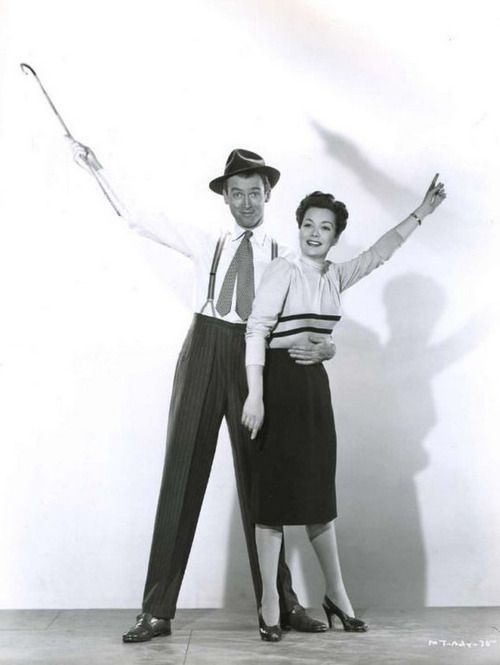
Classic dance clothes: Men take off your jackets!
 

***

I once read a story of two swing dance partners at a competition. The man was wearing high-rise, vintage pants held up by braces. He had worn the braces many times before and had no problems. The choreographed routine called for the woman to roll over the man’s back, and then be lifted upward by the man, his arms above his shoulders.

A pair of vintage dancers. Notice the man's high rise pants held up by braces


During the competition, everything was going as planned. However, as the women rolled over the man’s spine, something unexpected happened. The man bent down to hoist her up and his rear brace strap catapulted upward like a released balloon. The Y-back strap followed the lady skyward. In the blink of an eye, the once secure braces were now loose and flapping around the man’s upper body. Both the man and women were stunned, but smiled and carried on their routine. The braces flapped around and got entangled in hand-offs and dance moves. But worse was the man’s pants, which quickly lost their high-rise status and slowly sank lower and lower with every twist and move. They finished their routine and quickly left the stage, the man clutching his rear waistline and the lady attempting to help by pulling down on the rear brace strap.

Out of the spotlight, the lady felt responsible as the braces snapped off when she rolled over his back. She figured she had done something that caused the buttons to pop off. The man knew the lady meant no harm, and didn't do it intentionally. He was more interested in reattaching the strap, if possible. As a seamstress, the lady was the best person to mend it. She mentioned to the man that it was unusual for both buttons to pop off at the same time. She flipped the waistband over to inspect the inside of his pants. The lady found torn threads where a button used to be and, to her surprise, an anchored button still attached to the waistband! Instead of both buttons popping off, one button had stayed on.
She looked back at the rear brace tab and found that the leather on a tab had torn apart, separating the brace tab from the button. Under the pressure of the man bending down, the left button popped off and at the same time the brace tab separated. The brace tab couldn't hold and so tore apart. The tear in the brace tab was serious damage and could not be repaired. It was brittle, likely from getting damp from sweat during swing dancing, and then drying afterwards, as the women explained to the man. The constant cycle made the leather brittle.

Swing dancing with braces is very common


All was not lost though, she said, as one button was still securely attached to the man's waistband. The women suggested attaching the functioning brace tab to the other side where the remaining button was,  and the man agreed. The women pulled the dangling rear strap down and attached it to the single button. It looked slightly lopsided, but it would hold the man's pants up for the remainder of the day. As a safety check, the lady lightly pulling back and snapping the rear strap. All good to go, she said. The waistline returned to it's high-rise state. They were ready for the next routine later that day. But the man had learned his lesson: always check your braces buttons and brace tabs before a major competition.

Discussion
  • Are you a swing danger? Do you wear high-waist trousers or skirts with suspenders or straps?
  • Have you had any issues wearing braces or straps while dancing
  • If you wear braces with vintage pants or vintage high-rise skirts with straps when you go dancing, do people complement you on your look?

Friday, July 5, 2019

Summer style

Summer brings warm weather and a challenge to stay cool. You want your clothes to be airy and breathable: this is not the time for skin-tight pants. Even if your pants are roomy, the problem can be at the waist – when you tighten a belt around your waist. That’s exactly where braces are perfect for achieving summer coolness – in both meanings of the word! Braces suspend your pants at the waistline, not constrain it. This allows the waistline to be roomier and allow air to flow around your torso. 

While you may want to wear t-shirt and shorts all the time, this may not be suitable for all occasions. Take for example a wedding. It’s generally not appropriate to wear shorts, so a man must wear pants. However, he can be stylish and functional by wearing slightly roomier, high-waisted pants, supported by braces. Braces add a formal touch to your outfit and allow you to express your personality.

Maroon braces with pants and short sleeve dress shirt

Or in a corporate environment. It is generally not appropriate to wear shorts to the office, so pants are necessary for men or women. Here again, you can be stylish and functional by wearing slightly roomier, high-waisted pants, supported by braces. Braces add a sophisticated touch and express your personality. This style looks great on both men and women.

Classic black braces with black pants and no-sleeve dress shirt
Pants that allow air to flow around the torso will provide more a comfortable and cooler disposition. This can only be achieved if the pants are roomier and that can only be achieved with the help of braces. It’s a win-win, braces complement the outfit and provide air movement - style and function at the same time!

Roomy, stripped pants with braces


The goal is roominess rather than bagginess. This can be a fine line - be careful not to go overboard. Generally it’s one size up from your normal size.

Are you heading to a wedding or the office this summer? Wear braces for comfort and style. I’d love to hear your experience and what people’s comments were on your style.

Sunday, June 30, 2019

Suspender connections: Inverse-V compared to Inverse-U

After deciding whether to connect the straps to the waistline using clip-ons or buttons, the
next question is the style of connections for buttons. Button-on braces have 2 distinct styles: inverse-V and inverse-U tabs (or connections). 
Various brace connections (from left to right): inverse-V, cord, and inverse-U tabs


As implied by the name, an inverse-V tab has two small tabs, or strips of leather, that fan out from the shoulder strap and attach to the buttons on the waistline (left braces on the photo above). An inverse-U tab also has two tabs that attach to the two waistline buttons, but has a single leather strap that loops onto itself from one button to the other, centering on the shoulder strap (right braces on the photo above). Depending on the tension on the braces, it can resemble an inverse-V shape, but is more oval.
Comfortable and relaxed, the inverse-U tabs keep everything aligned

Both styles have their advantages and disadvantages. Inverse-V tabs are the traditional choice and were the first to appear in history. They offer a rigid anchor from the shoulder strap to the waistline. For example, leaning forward results in tension in the shoulder strap, pulling the inverse-V tab, putting pressure on the side brace button, and pulling the side of the waistline in the same direction. Inverse-V tabs are perfect for keeping the waistline at a constant height, especially the side of the pant waistline.

Historically, supporting the front (center seam) and side seam of the pants was important. In fact, for the front brace tabs, the traditional inverse-V tabs have the brace tabs closest to the center about half an inch longer in length compared to the tabs on the side (see photo below). This is to accommodate more portly men and to position the shoulder strap further to the side then straight down the middle of the chest. Look for this when you are considering purchasing inverse-V tab braces, as a way to discern if the braces are a true vintage piece (or replica). This style of tabs was very common in the 1930s and 40s.

Inverse-V tabs. Notice the center brace tabs are slightly longer
than the side brace tabs

Inverse-U tabs are somewhat more modern. They allow the shoulder strap to glide along the inverted U arch, in unison with the body’s movement. This provides more freedom and superior comfort. For example, leaning forward results in the shoulder strap sliding forward to the center button; leaning backwards, the strap slides backwards. At the rear, when you wear Y-back braces, when you lean left, the tab will shift to the left; when you lean right, the tab will shift to the right. Everything in line, everything comfortable.

To illustrate further, below is a photo of Robert Shaw playing Doyle Lonnegan in The Sting, 1973. He is wearing inverse-U tab braces, which I've highlighted in red. To show the difference, I've over-layed what an inverse-V tab brace would look like for comparison. In this still capture, as he bends down, the change in the shoulder straps position shifts. Notice how his strap on the inverse-U tab (red outline) shifts towards the inner center button, accommodating his body movement. This is in contrast to if he was wearing inverse-V tabs (the blue outline). The inverse-V tab would have stayed rigid and put strain on the outer side button, pulling up that area. Either way, his waistline stays well supported.

Doyle Lonnegan from The Sting, 1973

As you can likely see by now, inverse-U tabs result in less strain on the brace buttons compared to inverse-V tabs. This is because the inverse-U style allow the tension to be shifted as it glides along the arch, and minimizes tension over the two brace buttons rather than being locked into one position. This is likely the reason this style has become a predominant style for button braces, and my theory is that it results in less buttons popping off. This concept was fully used by President Suspenders in gliding and shifting to the body’s position.
Ad for President Suspenders showing the conforming nature to every movement

Further to this point, lumberjacks need braces to keep their jeans up during their strenuous manual labour. The most common style of braces for lumberjacks is X-back braces with inverse-U connections at the front. This provides solid support at the rear and flexibility for movement at the front. There are also inverse-V tabs at the front, but I generally see inverse-U tabs.
 

All this to say, I do still see a fair share of inverse-V connections and like them as well. 

Drawbacks

What are the drawbacks of each? For inverse-U tabs, if one of the buttons pops off (which is rare), the shoulder strap pulls to the end of the half circle and becomes slack. This would not have as large an impact for inverse-V tabs. If a button pops off, the tension in the shoulder strap remains relatively strong because the remaining brace tab is not dependent on the other brace tab to function. The released brace tab now flaps around, making its presence known. The inverse-U tab is dependent on both buttons staying anchored, whereas the inverse-V connection is not.

For inverse-V tabs there is more tension on the brace buttons, as it cannot glide. This is generally the case on the side brace buttons, which experiences more strain as people bend forward throughout the day. Case in point, this happened to this lady in the photo below:

Note the popped button and loose brace strap

When braces were very popular, most men chose inverse-U tabs. This is likely because of the comfort and flexibility they offered. If a button happened to pop off, you simply looped the dangling tab to the remaining anchor.


What should you wear: inverse-U or inverse-V tabs? Ultimately it’s a decision on whether you prefer a more rigid anchors or prefer to have your shoulder straps glide along and shift with your movements.


Personally, I have both inverse-V and inverse-U tabs and enjoy both. But if you ask me when do I forget that I’m wearing braces because they conform to my movement, it’s when I’m wearing inverse-U tabs. They accommodate the body’s movements so effortlessly!


Discussion:

  • Which style do you prefer: inverse-V or inverse-U tabs? Why?
  • Have you noticed how inverse-U tabs glide to align with your movement?

Thursday, June 27, 2019

Tales of a Brace-wearer (Part I)

A man was in his first week at a new corporate office. The corporate dress code was primarily suits but also blazers and dress pants.
One day the man was stopped by a couple of female colleagues. “Can we ask you a question?” one asked, “We’ve been talking about your style; your suits look so well put together.”
“Thank you,” said the man.
The lady continued, “Your clothes fit well, and you look comfortable in them: your shirt stays tucked in, your pants don’t drag on the ground, your pants stay at your waistline, you’re not constantly adjusting your pants like other guys around here. Your pants stay in place, but I don’t see you wearing a belt. If you don’t wear a belt, then you must be wearing … suspenders?”
Box-cloth braces
With a smile, the man flipped open his jacket to reveal a pair of royal blue braces.
“I knew it had to be suspenders!” exclaimed the second lady.
“Yes, these are the answer to why everything fits together. They are very comfortable and practical, and I don’t need to be concerned about my pants all day,” said the man.
 “What kind of suspenders are those? I have not seen suspenders with leather attachments at the waist before. How do they attach to the pants?”
“There are small buttons sewn onto the waistband of my pants. The straps are connected by these brace tabs that are either in an inverted-V or inverted-U – these are inverted-U. When suspenders attach to the pants with buttons they are generally called ‘braces’, and when they attach with alligator clips they are called ‘suspenders’. Some pants have the buttons on the outside of the waistband, some on the inside, depending on your preference.”
“I see,” said the second lady. “That’s so classy. I love the look. Buttons are more sophisticated than clips.”
“I prefer the buttons over the clips as well. In addition to being classy, when you have buttons there are more anchor points to keep my pants aligned all day long, regardless of my movements. But there’s more to it than just brace tabs attached to buttons. The buttons are positioned in specific locations along the waistline to anchor the pants, both at the front and back.” The man motioned with his hand, “let me explain: see how the buttons are aligned directly with the pleats, and on the side of the pants with the pockets?”
“Yes” agreed the women.
“The brace buttons secure the pants at the right locations – at the pleat line, to keep the line perfectly straight, and at the pockets. Think of it as an anchor here at the pleat line,” pointing to the location, “and an anchor here at the pockets. A single anchor - whether attached by a single brace tab or alligator clip - would be insufficient, regardless of where it is placed. That’s why clips simply don’t provide the same level of comfort and support for pants.”
“Now that you mention it, that makes sense. I’ve never thought about that. It’s no surprise that you look so put together – the pleats are kept straight with the brace buttons anchoring them at just the right places on the waistline,” said the first women.
 “Exactly; and the other side of the brace tabs anchor the side of the pants,” motioned the man.
“Yes, I can see how it works now,” said the lady. “How about on the back of the pants? How do the buttons anchor the pants?”
The man removed his jacket to show the rear, fish-tail back detailing.
The women breathed in, “Oh wow, these pants are designed for braces!”
“Exactly, the fabric over each leg comes to a climax at the anchoring brace buttons, which are held in line with the brace loop, which in turn is held perfectly in line with the rear brace strap. It all aligns perfectly to give a clean look at the back,” stated the man.
“Yes, I can see why your pants look so coordinated and fit so well,” said the women. “The pants are held up at all the right points to keep the pleats and pocket aligned, and at the rear over each leg.”
“That’s fantastic,” said the other lady. “The design of the pants fabric to come up to meet the braces is truly unique. It completes the look of the braces. I have never seen this before. It’s so stunning and sophisticated!”
“Thank you,” beamed the man.
 
“You don’t find pants like that off the rack in stores.”
“Agreed,” said the man.
“So where did you get them?”
“This pair I had custom-made. It’s called a ‘fish tail back’,” said the man.
“Going back to how braces attach to the pants – with buttons…” said the women.
“Yes, the buttons allow you to exchange one pair of braces with another for different looks. Sewing on buttons is an easy skill to learn,” said the man. “And it would be helpful to know, as buttons can sometimes pop off.”
The women smiled, “Ah yes, now that you mention it, I recall a black and white photo of working men with the brace tabs on one side connecting to only one point on the waistline, a button must have come off. Is that common?”
“It’s very rare for buttons to come off if they have been sewn on securely. Buttons don’t come off unless they’re under significant, prolonged pressure or the threads are worn down. I’ve been wearing braces for over 15 years and only had a few buttons pop off in that time. As the buttons are anchoring at the right locations, when one pops off you notice the change in tension and drooping pants right away. Men have been wearing braces with buttons for over 150 years, and if they didn’t withstand the daily demands of life back then, they couldn’t today.”
The man continued. “I find buttons grip far better over the long term than clips can. Aside from your buttons being anchoring points, clips snap off all the time as they only clinch the fabric, not firmly attach to it. Clips also damage the fabric, so for formal dress fabrics, clips should never be used. Braces stay firmly anchored with buttons. I like the vintage look of braces. Having been worn for over 150 years, they are timeless and classy.”
“Yes they are. I recall old photographs of men wearing braces and wondering why men don’t wear them anymore. Why aren’t more men wearing braces?”
“The height of the waistline on men’s pants is the primary reason,” the man responded. “Waistlines have inched lower and lower over time. Historically, waistlines were at or above the belly-button. This elongated the legs and made the man look taller. There is also a slight budge at the waist, so higher waisted pants pass smoothly over this budge. But in order to keep pants at this higher waist, braces must be used to support them.”
“I think another reason is that people associate suspenders with the clip-on variety and that’s a major turn off,” says the man. “Clips snap off, don’t anchor the pleat and side of the pants at the same time, and because you can easily take suspenders from one pair of pants to another, they look cheap. Braces are practical, stylish, and classy. I think more men should try braces and discover the comfort and confidence that comes with wear braces.”
“I agree,” chimed the women.
The man turned to go, but the first lady wasn’t finished. “As a stylish man, why do you leave your jacket on? Why not show off your braces and the stylish pants. I’m sure people would appreciate your style, as much as we have!”
“Thank you for the compliments on my style. Historically braces were considered an undergarment and not to be displayed. They were considered underwear and only your immediate family saw them. This thinking has changed and it’s now acceptable to display braces. But as braces are a vintage accessory, some of this traditional thinking carries on.”
“I see; but there are lots of old photographs of men showing their braces, without a jacket. I actually like seeing braces and the different styles and designs – it adds to the outfit. I love your pant style at the back, what did you call it? Fish-tail back? You don’t need to hide this special tailoring. I think you would agree with me,” turning to the other lady, “that braces can be proudly displayed.”
“Absolutely”, nodded the women.
“Thanks for the encouragement. And thanks again for the complements on my pants and braces.”
“You’re welcome.” 
The next day, the women gathered at the man’s office, eager to see his outfit for the day. He had taken off his blazer and was wearing a classy dress shirt with a pair of grey pants held in place by braces. The braces were stripped grey and navy.
“Love the braces; they complement your grey pants well,” admired the lady. “Are they fish-tail back pants today?”
The man stood up and smiled, turning around to reveal the fish-tail back details.

Monday, August 13, 2018

The wonder of high-rise pants held up with braces

I’ll just say it: I love high-rise pants. They create a striking visual image: they elongate your legs, shorten your torso, and cover your midsection. And they are held in place with braces! Pants designed for braces.


High-rise pants (sometimes called high-waist or high-waisted pants) sit at or above your belly button. This lengthens the pant leg and creates an smooth line from your shoulders down to your feet, uninterrupted by a belt. As the waistline is at or above your abdomen you can breathe comfortably, without having a restricted belt dig into you each time you take a breath. 

Notice how the high-rise pants elongate the legs and
creates a smooth transition form bottom to top half
In case you are unfamiliar with the term “rise”, this refers to the distance from the bottom of the crotch to the top of the waistline. A waistline sitting above your belly-button will have a ‘higher rise’ than a waistline that sits at your hips, for instance. It’s for this reason that jeans sitting below your hips are commonly referred to as “low risers.”

Back to high-rise pants. I especially love vintage, high-rise pants. Sometimes referred to as “Hollywood waist”, these pants do not have a separate band of fabric circling around the waist. Instead, the pant fabric extends up the legs right to the top of the pants, with no cross fabric for a belt that would interrupt the line. If there are belt loops, they are below, rather than at the top of the pant waistline. There are generally darts to angle the difference between the hips and the lower rib-cage. And that’s where the top of Hollywood waist pants ends: at the bottom of your rib-cage. To maintain this height, braces are attached.


Note the Hollywood waist on these high-rise pants for both men and women

Not only do high-rise pants make your look better, they make you feel better. Breathing is enjoyable! The pants sit comfortably above your waist, allowing your abdomen to expand and contract, all day long.  You take a breath in, and your abdomen fills out your pants waist. High-rise pants are large enough to absorb the breathe; just tight enough to be comfortable. You then breathe out, and your abdomen shrinks back into your body. With the absence of your abdomen, your pants would start to slide downward due to the effects of gravity. But they don’t - if you are wearing high-rise pants as they should be worn. Braces come to the rescue to provide fantastic support. Your high-rise pants stay high all day long.

No matter how much bending or twisting, braces keep your pants in place

The specific placement of the buttons along the waistline provides maximum support for this accomplishment. Brace buttons should be attached at the front above the center pant line and pocket above each leg (about 3-3.5 inches apart), and then equidistant from the center of the pants at the rear (about 1.5-1.75 inches from the center seam). It’s truly an enjoyment to sit, stand, bend, and twist - not to mention breathe - without having to adjust or pull up your pants. The braces do all the heavy lifting.

Proper button placement on these high-rise white pants worn by Farrah Fawcett
Charlene Tilton with improper button placement -
should be to the side to align with the pant line


With this in mind, I’m constantly perplexed that people turn to belts. Belts restrict movement and circulation around your waist and result in pants slipping down all day long. They interrupt the smooth transition from the top of your body to the bottom.

Men have an unfortunate aversion to wearing pants at or above their hips - why? Is this an outdated style of a previous generation? Do the pants not stay up (without braces, hence the need for braces), or men don’t like braces? I have not solved this question yet. But I do know that they're missing out on the wonder of high-rise pants and braces. Historically, when men wore pants, they were high-rise and held up with braces.


Vintage photo of men wearing braces
If I haven’t convinced you yet of the comfort of high-rise pants with braces, I’ll add one final point: braces are charming. People respect you when you make effort to dress well. High rise pants are one of those ways you can dress well and be stylish. Braces add a certain sophistication and refinement to an otherwise standard outfit. This writer from Esquire states that she highly regards suspenders and finds them to be darling. 

Current fashion trends are starting to take notice of the increase in rise of pants. Women’s fashion has emphasized high-rise pants for the past few years. In fact, check out this New Yorker article titled "How high can high-waisted pants go?" to understand that this rising trend will continue. It’s only a matter of time before it shifts to men’s clothing.

Courtshop James Jeans with braces

She's lov'n her high-rise pants with braces!

Discussion time:

  • Do you wear high-rise pants? If not, why not?
  • How do you find braces with high-rise pants?
  • Have you worn Hollywood waist pants?

Wednesday, September 20, 2017

Return of the Light Blue Pants

When I was a boy my parents bought me a pair of light blue dress pants. This was unlike any pair of pants I'd worn before, as the pants came with suspenders in the same color. The pants were high-rise, which was the trend at the time, and these pants came up just above my belly button. The pants had no waistband, rather the fabric came up all the way and just stopped. I’ve since learned this style is called ‘Hollywood Waist’. As a thin boy, the pants required the use of suspenders to hold them up, which is likely why they were included. The suspenders were Y-back and clipped-on to the hollywood waist. It made sense why there was no waistband - the pants were intended to be worn only with suspenders.

I remember wearing this outfit often - to holiday dinners, church, and weddings, especially in the summer time. I’d wear a checkered shirt or for more formal occasions, a white dress shirt. There was no suit jacket – just the pants and suspenders. I felt stylish in my pants and suspenders.

I remember other boys wore pants and suspenders as well. It was quite common back then.

Jump ahead 20 years, while hunting through a thrift store I came across a strikingly similar pair of light blue dress pants. This time in an adult size and without suspenders. When I saw them, my childhood memories of wearing the blue pants immediately came rushing to mind.

I was so surprised! I must have been staring at the pants too long, as the lady working in that department came by to ask how I was doing. I told her I used to wear a pair of pants similar to this when I was young and it was bringing back memories. She smiled and suggested I purchase them to relive my childhood. 

I agreed and shared my memories of wearing high-rise pants as a child with suspenders. She replied that she loved the look and that I should do the same with this pair. But, I said, this time I would wear the pants with button-on braces, instead of clip-on suspenders.

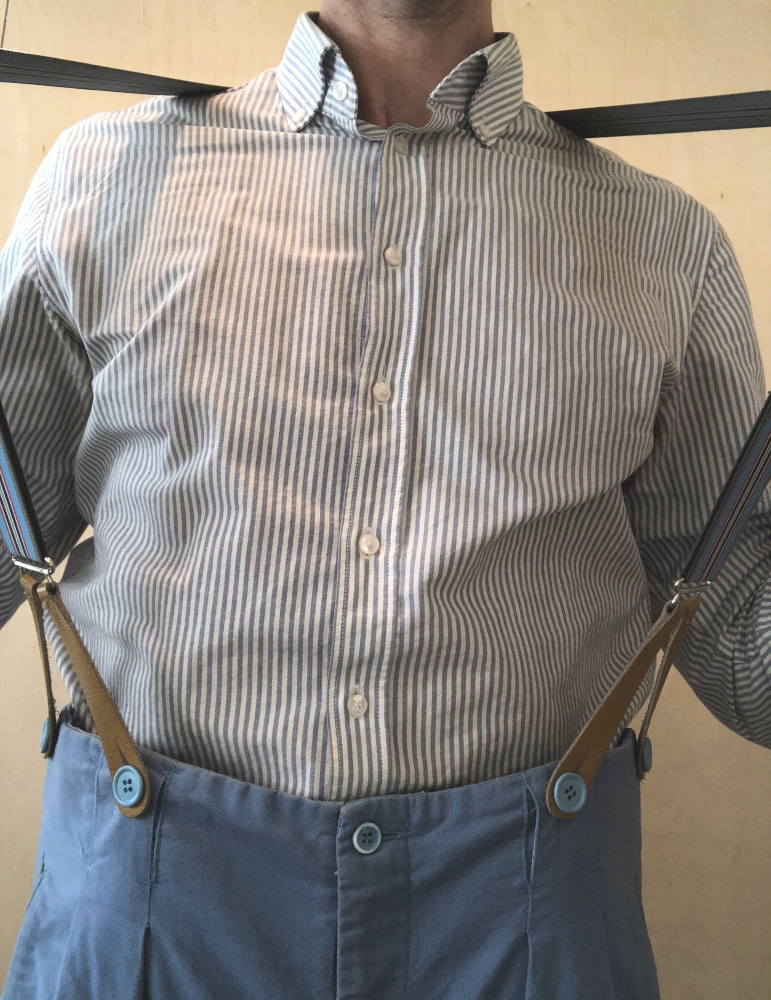
A few days later I removed the belt loops and sewed suspender buttons on the waistline. I sewed the buttons on the outside of the waistband to fit the vintage style of the pants. Buttons on the outside is very traditional, and I wanted to show the details of the suspender buttons against the brace tabs. Here’s a close-up of the brace tabs and exterior suspender buttons.

Here's another close-up with a different shirt:

Exterior suspender buttons against the brown brace tabs

The diamond pattern in the shirt complement the diamond braces.

Rear shot of braces

I love the look and feel of the pants; they are vintage and make a statement! It's the closest thing I can get to reliving my childhood!

Later this year I found another pair of light blue, high-waisted denim pants at a thrift store. They had a vintage design at the waist - no belt loops. Rather the pant fabric came up to top of the pants. These were again the Hollywood waist. They again reminded me of my childhood and wearing suspenders. These pants required suspenders to hold them up, but did not come with buttons, so I sewed them on, this time on the inside of the waistband.

High-waisted, light blue denim pants with braces

Rear shot of high-waisted pants

I bought these stripped Y-back braces long before I had light blue pants. They pair so well and I like the colors - the blue on the braces with the blue in the pants, and the red on the braces with the red in the dress shirt, the white on the braces and the white on the dress shirt. 


A few years later, after enough people had wanted to see the buttons attach at the waist, I decided that these pants would be better with the buttons on the outside of the pants. So I clipped them off and resewed the buttons onto the exterior of the waistline. 

Buttons on the outside

Rear shot of buttons on the outside

I like that people can see my buttons and braces. It's a vintage look that I enjoy and know others do as well.

These pants are larger at the waist, as you can see with the slight fish-tail back feature. Just like the pair of pants I had when I was young, these pants need braces to hold them up.

Evidence that my braces are suspending my loose waistline

Now when I wear either of these blue pants I'm reminded of my childhood, and where my love of high-waisted pants and suspenders all started.


Discussion time:

  • Did you wear suspenders growing up?
  • Do you continue to wear suspenders, or stopped after childhood?

Friday, March 4, 2016

Braces and Suspenders Observations

Have you noticed more people wearing braces? I have. And it’s not just people in one demographic, but young and old, males and females. Here are some styles I observed recently:
  • middle-aged women attending a group birthday party in a restaurant wearing blue jeans and a casual, white shirt. Instead of a belt, she went with clip-on braces
  • older businessman wearing grey pants and a navy blazer. As he was walking down the sidewalk a gust of wind opened his blazer to reveal his braces
  • 20-year old wearing black suspenders with a white dress shirt and black jeans
  • teenage girl wearing a green, knee-length skirt with suspender straps
  • women wearing denim shorts with red suspenders and a plaid shirt
I couldn’t photograph these outfits, so I’ll share what braces I’ve been wearing. This is a pair of Y-back stripped braces with brown leather tabs. The straps have a grey edge trim, with light blue and thin stripes of red, white, navy, and grey.


What braces or suspenders have you been wearing recently?