Showing posts with label button braces. Show all posts

Tuesday, August 11, 2020

The importance of the position of the rear junction

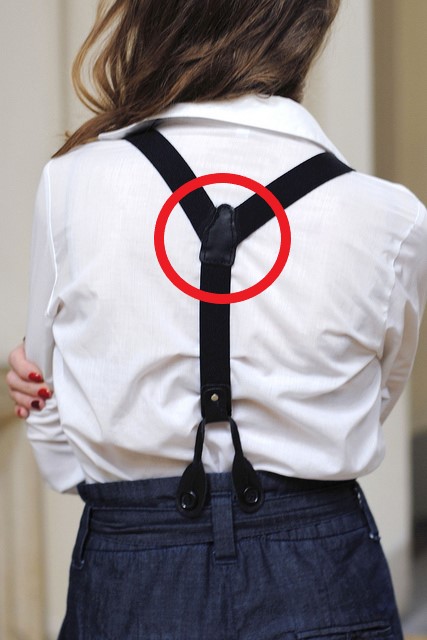
Brace straps cross over (X-style) or come together (Y-style) on the wearer's back. The place that they come together is referred to as the rear junction and it's one of the most important components of wearing braces, but not often considered. This post highlights different positioning and provides recommendations for you to enjoy brace wearing all the more.

The rear junction

The rear junction can either be fixed or movable. A fixed junction is more secure and is common on higher-end, luxury braces. A movable junction allows the wearer to shift the junction higher or lower on the torso to adapt the straps to the person's body.

Why is the rear junction placement important? Because straps slip off shoulders when the junction is too low. The higher the junction, the closer together the straps are as they run over the shoulders, and the less frequent they slip off. But you don't want the junction to be too high, that it's at your neck (see photo below). This causes the straps to curve around your neck rather than the shoulder blades.


Rear junction is too high

The optimal positioning of the rear junction is such that the straps curve along your shoulder blades as they run down your shoulders. This allows your shoulders to move freely while minimizing the possibility of the straps slipping of your shoulders.
The placement of the rear junction is a tad low


The placement of the rear junction is too low
Perfect positioning of the rear junction


The alternative is no rear junction. That is, two straps that simply run from the front of your pants to the back, never connecting at the rear to each other, such as this pair of braces:


While this may be possible, it is not recommended. The straps can easily slip off the shoulders and the shoulder blades have to contend with the strap when the shoulder moves forward.

 
I came across some video clips of Jennifer Lopez talling on the "The Elvis Duran Z100 Morning Show" and “HOT 97” on April 9, 2019 in New York City. 

Jennifer is wearing a simple white tank top with high-rise black pants. The pants have button-on black braces attached, giving a classic and stylish look. The high-rise pants sit above her waistline, allowing the braces to support them. 

I think this is a great outfit and don’t want to critique it. I couldn’t help notice as I watched the videos that Jennifer adjusted her brace straps twice during the 15 minute session. In the second clip, she adjusts her straps once (potentially more when not on camera). This tells me that either the rear junction of the braces is too low relative to her shoulders, or the straps simply run up and down her shoulders, not crossing in the back. We don’t see the rear view of the braces, so we will never know. 


If the straps cross at the back and the rear junction is fixed, her seamstress could sew excess fabric from the pants onto her waistband, thereby extending the rear brace tabs higher. This was a common solution in decades ago. Here's a photo for illustration:

Pant fabric can be used to extend the brace tabs higher

Looking at how close the placement of the buttons is on the waistline (basically next to each other and not spread apart), I think the braces simply run parallel over the shoulders - identical to the brown pants shown above. As stylish as it may be, the straps have a tendency to slip off the shoulders. And this is what was occurring to Jennifer’s straps during the interviews. 

On another interview with the Breakfast Club, we notice that her left suspender strap is twisted. This helps keep it in place, but as someone comments “Her left suspender is bugging my OCD”, “Me too! She fiddled with it at one point, but then it was still twisted.” It's not natural to have a twisted suspender strap or for the straps to slip off.

Jennifer’s stylist has some options: cross the straps in the back, or otherwise connect them potentially as an H-style, or tighten the straps. By making these adjustments Jennifer would  comfortably wear the braces without having to tinker and adjust them throughout the day.


Discussion:
1. Have you worn braces that slipped off your shoulders during the day?
2. Have you worn parallel braces?
3. Where do you prefer to have the rear junction?

Thursday, May 7, 2020

Popped brace buttons

Let's admit it: buttons pop off. It could be the button holding your waistline closed on your pants or skirt, buttons on your shirt or dress, or, as we are focusing here, brace buttons.

Brace buttons carry significant responsibility: to keep your pants up. You rely on them to do their role all the time. In fact, you probably don't think about the importance of their role until it's not there, that is, when the button is not there.


Contrary to belief, buttons popping off is not poor design. In fact, they are to protect the brace tabs. Would you rather have your brace tab break and be irreparable, or have a button pop off and simply replace the button? I think you'd agree that its easier to replace the button than the braces. There is an important engineering principal to use cheaper, replaceable parts (buttons) to minimize damage to more valuable parts (braces). Thus, by allowing buttons to pop off under significant stress, this saves the brace tabs and ultimately the braces. I would rather have a popped button than a broken button hole on the brace loop or broken braces.

One of the primary advantages argued by those in favor of clip-on suspenders is that buttons pop off and need time to sew them back on, whereas once a clip snaps off, it can be easily reattached. While this is true, it misses the point of that buttons are much more securely attached to the pants than a clip and the style benefits of buttons.

Easy come, easy go: Clip-ons are easy to attach, and easy to snap off


Buttons become detached for one of two reasons:
1. the button is pulled beyond it's capacity, and the thread capacity, and it gives way
2. the button is not under pressure, rather the button threads simply wear out over time resulting in the button slipping off

Let's look further at these 2 reasons.

1. Buttons under pressure
Given enough pull on the braces, buttons will pop off under sufficient strain. In West of Hot Dog (1924) a comedy with Stan Laurel, Stan is on way to collect an inheritance in the small town of Hot Dog when he is robbed by a gang of highwaymen. He's asked at gunpoint to come out of the carriage, which Stan signals he'll happily do by exiting the opposite side of the carriage - in order to make his getaway. Stan turns to exit, with his braces as the only thing available to restrain him. The highwaymen grabs the rear brace straps and pulls as Stan pushes forward. The camera angle shows Stan's rear braces pop off under the strain:

Rear buttons popping off under the strain
 
Stan falls forward, but the braces restrain him. The highwayman pulls the braces and Stan exits the carriage towards the highwayman. Stan's braces no longer hold up his pants and the remainder of the scene shows in comical fashion what happens when Stan raises his hands for the gunman.

Notice that the brace tab button holes on his braces are still intact. All Stan needs is two new buttons to be sewn on to his pants and he can use his braces again. Also notice the durability of the left button - only popping off after significant pressure. So unless someone has the braces in their firm grip and pulling them with all their might, braces generally do not pop-off. 

Clip-on suspenders snap off all the time and would need to be constantly attached, which is annoying - your pants are not held up when your suspender clips keep snapping off! The fact is, clip-on suspenders would have snapped off a lot sooner than the buttons popped off in this case. Therefore, use buttons.

Testing if any buttons will pop off

Brace thread
Ensuring buttons stay attached can partially be addressed by using a strong thread. But balance is needed when determining the strength of the button threads to anchor braces – too strong and the brace strap will break from pressure resulting in the braces not being usable, too weak and the button threads will be constantly failing and buttons popping-off, resulting in the need to sew on buttons. Therefore, use a stronger thread weight and strength for sewing on brace buttons.
 
This brace button is separating from the waistline as the thread is lengthened. The button is about to pop off due to poor quality brace thread


2. Button threads wearing out
Similar to other fabrics, thread can wear out over time, especially with constant use. It's also very thin and can be ground down. As a result, there can be a slow tearing of the thread that eventually causes the button to release. Sometimes this is quick and sometimes it's a very slow process.
 
I remember observing a man in a suit with his jacket off one summer day outside an office tower. He was wearing Y-back braces. His rear brace tabs were about an inch from the top of his waistline, as the braces were hanging on by a few strands of thread (similar to the photo of the lady above). It would only be a matter of time before those threads would give way and the buttons would not be secured to the waistline.


I used to think that brace buttons always became detached from strain or when pulled. Maybe it's because that's what I saw in movies and comics. I've come to learn from wearing braces for many years that this is not always the case - sometimes it's simply that the button thread wears out.

Case on point, I was working at a professional office a while back. I was wearing a brown pair of dress pants with stripped blue, inverse U-tab braces and a dress shirt. I had taken my suit jacket off for the day (as was customary). I went throughout my day with my braces on display and didn't think anything of it. The pants were securely attached and held in place by my braces - or so I thought.

Late in the afternoon I was walking down the hallway when a considerate lady stopped me to ask if my pants felt secure. I replied, "yes, thanks to my braces," lightly tugging on my straps. She clarified that she meant the rear of my pants.

A popped button on the rear inverse-U tab braces
"Do you know that one of your attachments is disconnected at the back?" I was shocked and instinctively reached back with my hand to confirm it was true. One side of my inverse U-tab had slid all the way up and the rear strap was only anchored by one button. I hadn't felt the change in tension at any point during the day!

"Oh no, you're right. I've popped a brace button," I said, feeling self-conscious and blushing. 
 
She smiled and said, "Don't worry, that can happen with any button. Buttons are easy to sew on. I bet you can sew another one on easily."
 
"Yes, I'll have to do that," I replied.
 
She continued on by stating how much she liked that I wear braces. "Your braces are so stylish and befitting of you. You look very dapper and professional. I hope you don't stop wearing braces because one button popped off?"
 
"No, definitely not," I replied. I thanked her and forced a smile.
 
While one button was detached and provided no support, I still felt secure and confident that my pants would stay where they should be, which is something you can't say for those wearing belts.


On another occasion in the winter, I was wearing jeans, a t-shirt, sweater, and jacket outside in the snow. As I was walking along I felt my front right strap lose tension. I didn't stop as I figured the button had popped off and slipped down my pants and into my boot, as it was sewn on the inside of the waistband. Unfortunately, when I got inside to inspect, the inner button had popped off. But I couldn't find it when I shook my pants and looked in my boot. It must have pulled above the waistline and when it popped off, it fell outside the pants rather than inside. As the button was white and had fallen in white snow, I couldn't find it. I sewed another button on to replace the lost one and I was good to go.
 
In the summer time, when the snow had melted, I was walking along the same path with a friend. She pointed and said, there's a button. Is that one of your suspender buttons?
 
I looked down and picked up the white button.
 
Yes, I said, I think so, slipping it into my pocket. That button popped off my pants in the wintertime and I couldn't find it in the snow.
 
I like your button suspenders, she said. 
 
I agreed.


In conclusion, don't be too concerned about buttons popping off - it's a right of passage for us wearing braces.
Monday, February 17, 2020

Time to bring back the classics

Do you look at old photographs and magically insert yourself into the scene, such as this one...
Men strolling down the sidewalk in Paris, 1928

I'd love to join in with these men as they stroll down the sidewalk in 1928, all wearing high-waisted pants with braces. The photo's description says it was during a heatwave in 1928 - I'd be walking around without a suit jacket as well.

Do you imagine a time when people put thought into how they dressed, even on the weekend? Back when men wore suits, and women wore dresses regularly. Some people refer to this as the Golden age of mens style.

While I’d love to be transported into that bygone era. I realize that life was challenging back then and things we take for granted today were unheard of back then. I’d like to focus on the fashion aspect of the bygone era, rather than the troubles.

Here's a photo I could see myself in:

Photo of a new family
Even at home the man is wearing a suit. He's conveniently pulled back his suit jacket to reveal his braces supporting his high-rise pants. Notice the proper placement of the buttons - above the center pleat and then to the side above the pocket. The inverse-U tab appears a bit stretched, but works well to support his pants over the front waistline.


Women wore dresses or high-waisted skirts. Stockings were worn over their legs and held in place with suspenders (also called garters) which sometimes needed adjusting.
Adjusting the suspenders

Men always wore suits, even at home. When the man came home, he would take off his hat (another stylish accessory now forgotten), remove his suit jacket, and carry on with his day. No one would think twice about seeing his high-waisted pants held up with braces. It was totally acceptable to have the braces visible. In fact, it was appreciated, as the pants lengthened his appearance, did not drag on the ground, or get torn at the hem.
A father reading with his son. His suit jacket is off and he looks very comfortable

Both men and women understood that suspenders were an essential accessory - for holding up pants and for holding up stockings. High-waisted pants, skirts, and stockings were secured by braces. No decent individual would expect anything less; they were effective and comfortable. Braces proliferated the everyday scene in the home and at the office.

At home: the man's suit jacket is off, sleeves rolled-up, and his braces are totally acceptable  

At the office: every man's suit jacket is off and it's acceptable to show their braces

If you walked into any office building, you would not be surprised to see the majority of men wearing braces. Braces would be quietly doing their part, keeping mens pants looking respectable and dapper. Women wore pinafores and skirts with fabric straps, or skirts with button-on braces. Pants and skirts were meant to be kept high, and braces met that need.

This was before the days of throw-away fashion. People bought quality clothing and reused them over and over – or handed them down repeatedly. As such, some clothes could be loose, requiring braces to keep the lower-half of the outfit in place. People expected braces to be worn to fill this need.


Besides looking at old photographs, there are certain communities and events that celebrate fashion from the past. There are annual tweed rides in major cities. Or take Goodwood Revival festival in England. In addition to racing cars and planes, there’s also the style aspect. People dress in vintage styles, with plenty of braces and high-waisted skirts around. At 2019's festival, the winner of the Best Dressed Competition in the men's category wore a 1940's civilian style of grey, high-rise pants with stripped braces on a blue shirt and a vintage, red tie and grey hat:

Of course he won - he looks like he stepped out of the 1940's!

For those who appreciate an era when men wore braces, and hats were commonplace, these events are a welcomed reprieve from modern life.

Discussion

  • Have you attended events with vintage themes?
  • Do you wear clothes that are styled from a bygone era?

Wednesday, September 18, 2019

Swing Dancing and Braces

Swing dancing originated in the 1920s, and is connected with Jazz and Big Band music. Style reflects culture and this was true during this period. Dancers took up the clothing of time, which was heavily influenced by the social ideas of the day. Style was reflected in music, which was flamboyant, easy-going, and unique. 

Swing dancing was meant to be fun and relieve stress. It was a social activity that allowed you to connect with people. All ages came together at the dance hall to meet others, talk, and usually dance.

Here's some videos to illustrate the style, music, and dance. 

Here's some lindy hop dancers from the movie Day at the Races (1937) and a color version here. All of the male dancers wear braces to keep their high-rise pants high! The opening dance off with the portly man shows how useful braces are to swing dancers - he would not be able to pull off his moves and keep his pants from sliding down without the help of braces.

This man's ready to dance, wearing braces with his high-rise trousers

During this era women wore knee-length, pleated or circular skirts and dresses in flamboyant colors. The key was that the bottom half had plenty of material for dancing and allowed the material to flow wave like a flag. If wearing a skirt, it was usually high-waisted, sometimes with braces or simple straps over the shoulders to accommodate the high waist. 

A classy swing, circular skirt with built-in shoulder straps

Men always wore full suits: a jacket and tie, and sometimes a vest. Akin to the ladies style, men’s suit pants were high-rise held up with button-on braces.

Another example is from the 1943 movie, "Kid Dynamite". The scene opens with 2 ladies pinning dance numbers on the back of their partner's suit jackets. The ladies are both wearing high-waisted skirts with suspender straps attached. One lady's straps cross in the back and the other lady's straps do not. As you'll find out, this causes a problem.

The men are wearing suits. During the scene, as the dancers move around, the jackets open and we catch glimpses of high-waisted pants, which would have been held up with braces. 


The dancing commences and dancers start to boogie and move in all different positions. They twist and turn and enjoy dancing. It's a fantastic time. At the 3:25 mark, the lady's right suspender strap slips off her shoulder. Her straps don't cross in the back, and with all the movement, the strap can't stay in place on her shoulder. Switching back to the other dance partners, the lady's crossed shoulder straps are in place even though she's widely dancing around as well. The song ends and the lady pulls her suspender strap up again. This would get annoying, and is the reason for crossing the straps in the back.

Here's another video that illustrates both of these styles: a pair of lindy hop dancers, Dean and Jewel. They are wearing quintessential swing dance outfits: Dean is wearing white, high-rise pants with braces, and Jewel is wearing a flamboyant skirt with shoulder straps. Her vertical straps have a horizontal strap in the same fabric across her bust, which keeps her straps in place, regardless of her vigorous movement.

Coles and Atkins jazz dancers in classic high-rise trousers with braces and suit jacket

And finally, women sometimes opted for high-rise trousers when dancing and wore suspenders with them, such as this lady:

Lady dancer wearing Lederhosen-style suspenders

I find it interesting that both women’s and men’s styles have two common features:

  1. Roomy and comfortable fit: the clothes were not skin tight or overly baggy. Skirts and pants were roomy to allow air movement and flow of the fabric; they were not tight or restrictive.
  2. High-rise: the waistline of skirts and pants was at the belly button, or higher - at the rib cage. The high-rise provides a lengthening effect of the legs.
Both dancers are wearing braces

The combination of these two features required a third feature: braces or straps, as roomy pants and skirts need to be held up at the high waistlines. Belts simply were able to support the pants or skirt at the high waistline. It’s no surprise then that people during this era wore braces – it fit the style! It’s also not surprising that swing dancers continue to wear this style.


Notice the braces on the lady's skirt

The activity of swing dancing involves a lot of movement – twisting, bending, and shuffling to name a few. Braces are excellent at moving in tandem with the body with the constant movement, and maintaining the waistline and pants (or skirt) at their proper position. 

Classic dance clothes: Men take off your jackets!
 

***

I once read a story of two swing dance partners at a competition. The man was wearing high-rise, vintage pants held up by braces. He had worn the braces many times before and had no problems. The choreographed routine called for the woman to roll over the man’s back, and then be lifted upward by the man, his arms above his shoulders.

A pair of vintage dancers. Notice the man's high rise pants held up by braces


During the competition, everything was going as planned. However, as the women rolled over the man’s spine, something unexpected happened. The man bent down to hoist her up and his rear brace strap catapulted upward like a released balloon. The Y-back strap followed the lady skyward. In the blink of an eye, the once secure braces were now loose and flapping around the man’s upper body. Both the man and women were stunned, but smiled and carried on their routine. The braces flapped around and got entangled in hand-offs and dance moves. But worse was the man’s pants, which quickly lost their high-rise status and slowly sank lower and lower with every twist and move. They finished their routine and quickly left the stage, the man clutching his rear waistline and the lady attempting to help by pulling down on the rear brace strap.

Out of the spotlight, the lady felt responsible as the braces snapped off when she rolled over his back. She figured she had done something that caused the buttons to pop off. The man knew the lady meant no harm, and didn't do it intentionally. He was more interested in reattaching the strap, if possible. As a seamstress, the lady was the best person to mend it. She mentioned to the man that it was unusual for both buttons to pop off at the same time. She flipped the waistband over to inspect the inside of his pants. The lady found torn threads where a button used to be and, to her surprise, an anchored button still attached to the waistband! Instead of both buttons popping off, one button had stayed on.
She looked back at the rear brace tab and found that the leather on a tab had torn apart, separating the brace tab from the button. Under the pressure of the man bending down, the left button popped off and at the same time the brace tab separated. The brace tab couldn't hold and so tore apart. The tear in the brace tab was serious damage and could not be repaired. It was brittle, likely from getting damp from sweat during swing dancing, and then drying afterwards, as the women explained to the man. The constant cycle made the leather brittle.

Swing dancing with braces is very common


All was not lost though, she said, as one button was still securely attached to the man's waistband. The women suggested attaching the functioning brace tab to the other side where the remaining button was,  and the man agreed. The women pulled the dangling rear strap down and attached it to the single button. It looked slightly lopsided, but it would hold the man's pants up for the remainder of the day. As a safety check, the lady lightly pulling back and snapping the rear strap. All good to go, she said. The waistline returned to it's high-rise state. They were ready for the next routine later that day. But the man had learned his lesson: always check your braces buttons and brace tabs before a major competition.

Discussion
  • Are you a swing danger? Do you wear high-waist trousers or skirts with suspenders or straps?
  • Have you had any issues wearing braces or straps while dancing
  • If you wear braces with vintage pants or vintage high-rise skirts with straps when you go dancing, do people complement you on your look?

Monday, August 13, 2018

The wonder of high-rise pants held up with braces

I’ll just say it: I love high-rise pants. They create a striking visual image: they elongate your legs, shorten your torso, and cover your midsection. And they are held in place with braces! Pants designed for braces.


High-rise pants (sometimes called high-waist or high-waisted pants) sit at or above your belly button. This lengthens the pant leg and creates an smooth line from your shoulders down to your feet, uninterrupted by a belt. As the waistline is at or above your abdomen you can breathe comfortably, without having a restricted belt dig into you each time you take a breath. 

Notice how the high-rise pants elongate the legs and
creates a smooth transition form bottom to top half
In case you are unfamiliar with the term “rise”, this refers to the distance from the bottom of the crotch to the top of the waistline. A waistline sitting above your belly-button will have a ‘higher rise’ than a waistline that sits at your hips, for instance. It’s for this reason that jeans sitting below your hips are commonly referred to as “low risers.”

Back to high-rise pants. I especially love vintage, high-rise pants. Sometimes referred to as “Hollywood waist”, these pants do not have a separate band of fabric circling around the waist. Instead, the pant fabric extends up the legs right to the top of the pants, with no cross fabric for a belt that would interrupt the line. If there are belt loops, they are below, rather than at the top of the pant waistline. There are generally darts to angle the difference between the hips and the lower rib-cage. And that’s where the top of Hollywood waist pants ends: at the bottom of your rib-cage. To maintain this height, braces are attached.


Note the Hollywood waist on these high-rise pants for both men and women

Not only do high-rise pants make your look better, they make you feel better. Breathing is enjoyable! The pants sit comfortably above your waist, allowing your abdomen to expand and contract, all day long.  You take a breath in, and your abdomen fills out your pants waist. High-rise pants are large enough to absorb the breathe; just tight enough to be comfortable. You then breathe out, and your abdomen shrinks back into your body. With the absence of your abdomen, your pants would start to slide downward due to the effects of gravity. But they don’t - if you are wearing high-rise pants as they should be worn. Braces come to the rescue to provide fantastic support. Your high-rise pants stay high all day long.

No matter how much bending or twisting, braces keep your pants in place

The specific placement of the buttons along the waistline provides maximum support for this accomplishment. Brace buttons should be attached at the front above the center pant line and pocket above each leg (about 3-3.5 inches apart), and then equidistant from the center of the pants at the rear (about 1.5-1.75 inches from the center seam). It’s truly an enjoyment to sit, stand, bend, and twist - not to mention breathe - without having to adjust or pull up your pants. The braces do all the heavy lifting.

Proper button placement on these high-rise white pants worn by Farrah Fawcett
Charlene Tilton with improper button placement -
should be to the side to align with the pant line


With this in mind, I’m constantly perplexed that people turn to belts. Belts restrict movement and circulation around your waist and result in pants slipping down all day long. They interrupt the smooth transition from the top of your body to the bottom.

Men have an unfortunate aversion to wearing pants at or above their hips - why? Is this an outdated style of a previous generation? Do the pants not stay up (without braces, hence the need for braces), or men don’t like braces? I have not solved this question yet. But I do know that they're missing out on the wonder of high-rise pants and braces. Historically, when men wore pants, they were high-rise and held up with braces.


Vintage photo of men wearing braces
If I haven’t convinced you yet of the comfort of high-rise pants with braces, I’ll add one final point: braces are charming. People respect you when you make effort to dress well. High rise pants are one of those ways you can dress well and be stylish. Braces add a certain sophistication and refinement to an otherwise standard outfit. This writer from Esquire states that she highly regards suspenders and finds them to be darling. 

Current fashion trends are starting to take notice of the increase in rise of pants. Women’s fashion has emphasized high-rise pants for the past few years. In fact, check out this New Yorker article titled "How high can high-waisted pants go?" to understand that this rising trend will continue. It’s only a matter of time before it shifts to men’s clothing.

Courtshop James Jeans with braces

She's lov'n her high-rise pants with braces!

Discussion time:

  • Do you wear high-rise pants? If not, why not?
  • How do you find braces with high-rise pants?
  • Have you worn Hollywood waist pants?