 |
| The rear junction |
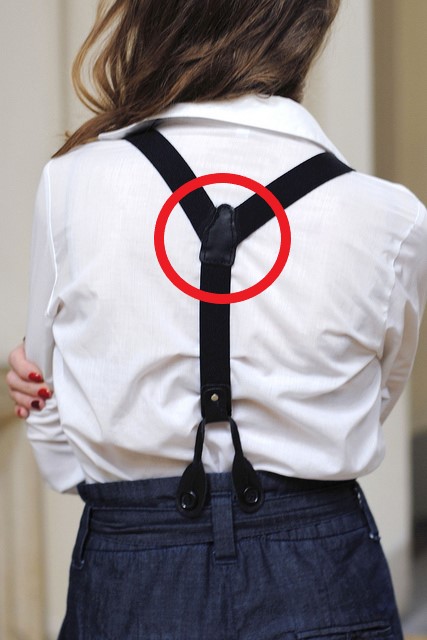
The rear junction can either be fixed or movable. A fixed junction is more secure and is common on higher-end, luxury braces. A movable junction allows the wearer to shift the junction higher or lower on the torso to adapt the straps to the person's body.
Why is the rear junction placement important? Because straps slip off shoulders when the junction is too low. The higher the junction, the closer together the straps are as they run over the shoulders, and the less frequent they slip off. But you don't want the junction to be too high, that it's at your neck (see photo below). This causes the straps to curve around your neck rather than the shoulder blades.
 |
| Rear junction is too high |
The optimal positioning of the rear junction is such that the straps curve along your shoulder blades as they run down your shoulders. This allows your shoulders to move freely while minimizing the possibility of the straps slipping of your shoulders.
 |
| The placement of the rear junction is a tad low |
 |
| The placement of the rear junction is too low |
 |
| Perfect positioning of the rear junction |
 |
| Perfect positioning of the rear junction |
The alternative is no rear junction. That is, two straps that simply run from the front of your pants to the back, never connecting at the rear to each other, such as this pair of braces:


While this may be possible, it is not recommended. The straps can easily slip off the shoulders and the shoulder blades have to contend with the strap when the shoulder moves forward.
 I came across some video clips of Jennifer Lopez talling on the "The Elvis Duran Z100 Morning Show" and “HOT 97” on April 9, 2019 in New York City.
Jennifer is wearing a simple white tank top with high-rise black pants. The pants have button-on black braces attached, giving a classic and stylish look. The high-rise pants sit above her waistline, allowing the braces to support them.
I think this is a great outfit and don’t want to critique it. I couldn’t help notice as I watched the videos that Jennifer adjusted her brace straps twice during the 15 minute session. In the second clip, she adjusts her straps once (potentially more when not on camera). This tells me that either the rear junction of the braces is too low relative to her shoulders, or the straps simply run up and down her shoulders, not crossing in the back. We don’t see the rear view of the braces, so we will never know.
If the straps cross at the back and the rear junction is fixed, her seamstress could sew excess fabric from the pants onto her waistband, thereby extending the rear brace tabs higher. This was a common solution in decades ago. Here's a photo for illustration:

Pant fabric can be used to extend the brace tabs higher
Looking at how close the placement of the buttons is on the waistline (basically next to each other and not spread apart), I think the braces simply run parallel over the shoulders - identical to the brown pants shown above. As stylish as it may be, the straps have a tendency to slip off the shoulders. And this is what was occurring to Jennifer’s straps during the interviews.
On another interview with the Breakfast Club, we notice that her left suspender strap is twisted. This helps keep it in place, but as someone comments “Her left suspender is bugging my OCD”, “Me too! She fiddled with it at one point, but then it was still twisted.” It's not natural to have a twisted suspender strap or for the straps to slip off.
Jennifer’s stylist has some options: cross the straps in the back, or otherwise connect them potentially as an H-style, or tighten the straps. By making these adjustments Jennifer would comfortably wear the braces without having to tinker and adjust them throughout the day.
Discussion:
1. Have you worn braces that slipped off your shoulders during the day?
2. Have you worn parallel braces?
3. Where do you prefer to have the rear junction?


